

The Grandmaster Next Door: John Emms
John Emms has beaten a future five-time World Champion, written more chess books than most of us own, and still lives four miles up the road from our Monday-night clubroom.
A Tunbridge Wells Chess Club feature · July 2026
In April 1986, on board one at a junior tournament in the Rutland town of Oakham, a nineteen-year-old from Norwich beat a sixteen-year-old boy from Madras. The nineteen-year-old was John Emms. His opponent was the sixteen-year-old Viswanathan Anand, years before he became India’s first grandmaster and, eventually, a five-time World Chess Champion.
It barely rates a footnote in Emms’s own record of the game. It’s one of 1,384 tournament games in a personal ChessBase export of his results, filed a few pages from wins over the English grandmasters John Nunn and Julian Hodgson, and a long, ongoing back-and-forth with the players who came to define his era — Michael Adams, Matthew Sadler, Jonathan Mestel, Keith Arkell. Emms has been quietly good at this for a very long time. He just doesn’t make a fuss about it.
Which is partly why we’re making the fuss for him. John Emms lives in Hildenborough, a few minutes from our clubroom on London Road, and this corner of Kent has had a working grandmaster in it for the better part of two decades without most of us stopping to say so.
01 · From Norwich to Grandmaster
John Michael Emms was born in Norwich on 14 March 1967. “My dad taught me the moves when I was five or six years old,” he has said of his start in the game — and from there the rise was steady rather than sudden. English chess in the 1980s was thick with talent, but Emms didn’t get lost in it: he won the Politiken Cup, the big Danish open, jointly in both 1992 and 1993, and was awarded the Grandmaster title in 1995.
Two years later came the closest he has ever gone to the outright British crown. At the 1997 British Championship in Hove, four players tied for first on 8/11 — Emms among them, alongside Michael Adams, Matthew Sadler and the great Tony Miles. A play-off couldn’t separate the leaders outright, and the title ended up shared between Adams and Sadler. Two summers later, at the 1999 Championship, Emms reached his career-peak FIDE rating of 2586 — and played the mating attack you’ll find further down this page.
He represented England at the Istanbul Olympiad in 2000 and again at Bled in 2002, where he served as playing captain. Two years after that, he coached the England women’s team at the Olympiad in Calvià, Mallorca.
02 · More books than most players own
Alongside the playing career runs a second one: Emms is among the most prolific chess writers of his generation, with more than thirty books published since 1998, chiefly for Everyman Chess and Gambit Publications. What club players actually recommend him for isn’t the volume, though — it’s the approach. Discovering Chess Openings, probably his best-loved title, is built around a coach’s instinct rather than an author’s: instead of handing the reader lines to memorise, Emms asks the questions a good teacher asks, and lets you arrive at the principle yourself. It’s pitched exactly at the player who has outgrown beginner manuals but isn’t ready for dense theory — which is to say, most of a club’s membership.
The catalogue runs wide from there — the Sicilian, the Ruy Lopez, the Nimzo-Indian, the Scandinavian, endgame technique (The Survival Guide to Rook Endings), general instruction (Simple Chess). In 1999 he co-wrote Nunn’s Chess Openings with John Nunn, Joe Gallagher and Graham Burgess — worth mentioning mainly because, a few years earlier, Emms had beaten Nunn over the board at Walsall. And in 2000, for Gambit, he put out both The Ultimate Chess Puzzle Book and Most Amazing Chess Moves of All Time. He literally wrote the book on this article’s subject matter. It turns out he had plenty of his own material to draw on — see below.
03 · Still playing for England
Approaching sixty, Emms is still turning out for his country. He plays board four for England’s over-50s team — alongside fellow grandmasters Mark Hebden, Keith Arkell, Glenn Flear and Chris Ward — a squad that has successfully defended its European title and finished fourth of thirty-six nations at this year’s World Senior Team Championship in Durrës, Albania, where Emms won his own game as the team beat Iceland in round three.
The man he mated at the British Championship in 1999 is now the man standing next to him on England’s team sheet. — Keith Arkell, opponent, then teammate
04 · The Tunbridge Wells connection
In October 2015, Emms gave up a Saturday to play a simultaneous exhibition at Salomons Estate against 34 young players from ten schools across the Tunbridge Wells area, organised with Tunbridge Wells Chess Club. He didn’t lose a single game. Four juniors held him to draws: Freddie Hand and David Liu of the Judd School, Oleg Lyakh of Skinners’ School, and Grace Lamb from Groombridge.
“The standard of chess was very high,” said Michael Shahoud, the club’s captain at the time. “Despite that, and the fact that two of the young players facing him were graded at more than 170, John did not lose a single game — which was quite an achievement, and highlighted just how well Freddie, David, Oleg and Grace played to hold him to draws.”
It wasn’t a one-off appearance. A few miles further up the road in Sevenoaks, Emms has run the Advanced Chess Club at Solefield School every Thursday afternoon since October 2014, working with a small group of keen improvers rather than treating it as a competition. He also coaches for the Kent Junior Chess Association — alongside his England teammate Chris Ward — and teaches for the Delancey UK Schools’ Chess Challenge. Junior chess in this corner of Kent has had a grandmaster quietly looking over its shoulder for the best part of a decade.
⚑ Two brilliancies from the archive
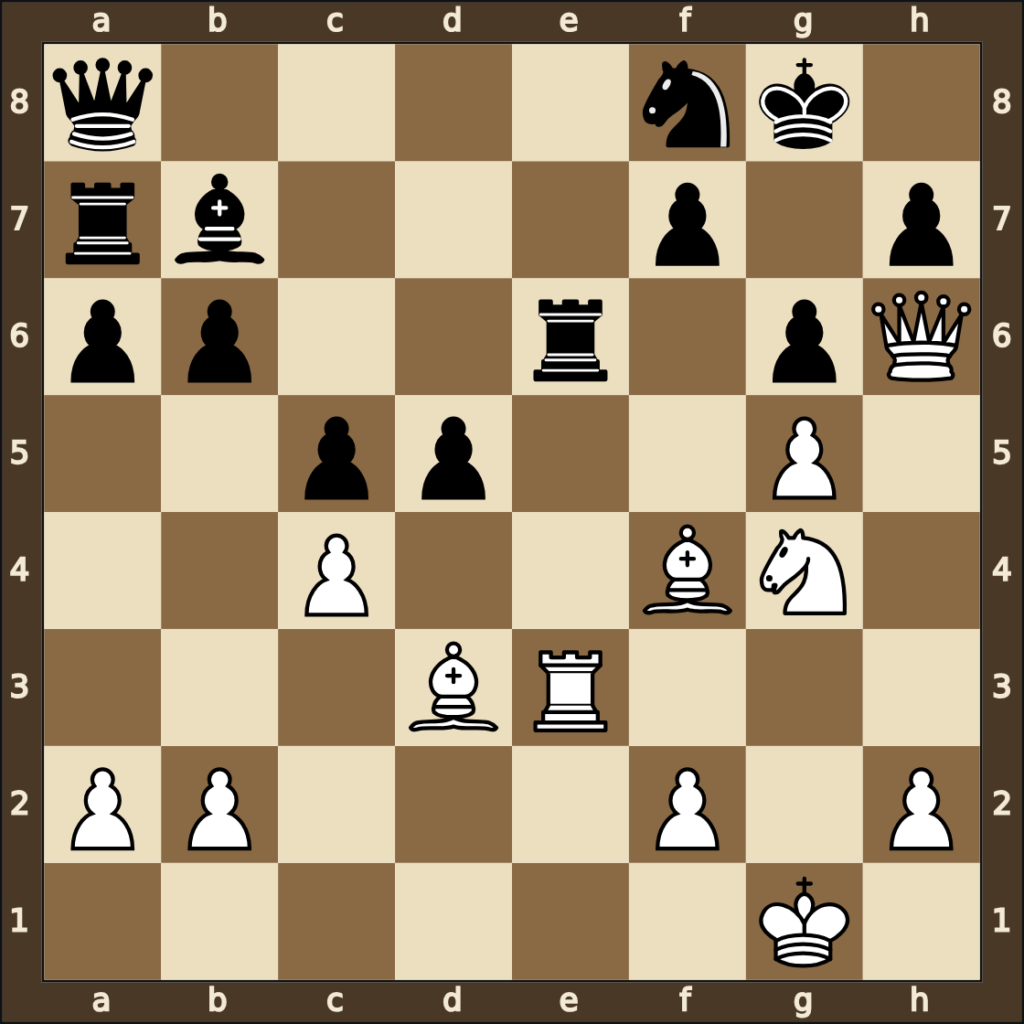
We went through a personal ChessBase export of 1,384 of Emms’s tournament games, from 1982 to 2025, looking for moments worth putting in front of a solver — ideally ones that also say something about how he actually plays: solid until the position allows him to sharpen it, then decisive. We checked every candidate with a chess engine to make sure the lines actually held up before we trusted them. Two survived that test comfortably enough to sit alongside anything in a Saturday newspaper chess column. Set up a board, start a clock, and see how you get on. Full solutions — plus the technical finish of that Anand game — are on a separate page, linked at the bottom.
Puzzle One · White to Play
Emms – Arkell British Chess Championship, 1999 — the year of Emms’s career-peak rating, against a grandmaster who, twenty-seven years on, is now his teammate on England’s seniors squad.
Puzzle Two · White to Play
White to play. Black’s king looks safe enough behind its pawns. It isn’t. Find the move that starts the demolition — then work out how Black’s replies are answered.
Emms – Holzke Bundesliga, 2004/05 — Germany’s top team league, against Frank Holzke, a German grandmaster rated 2492 at the time.
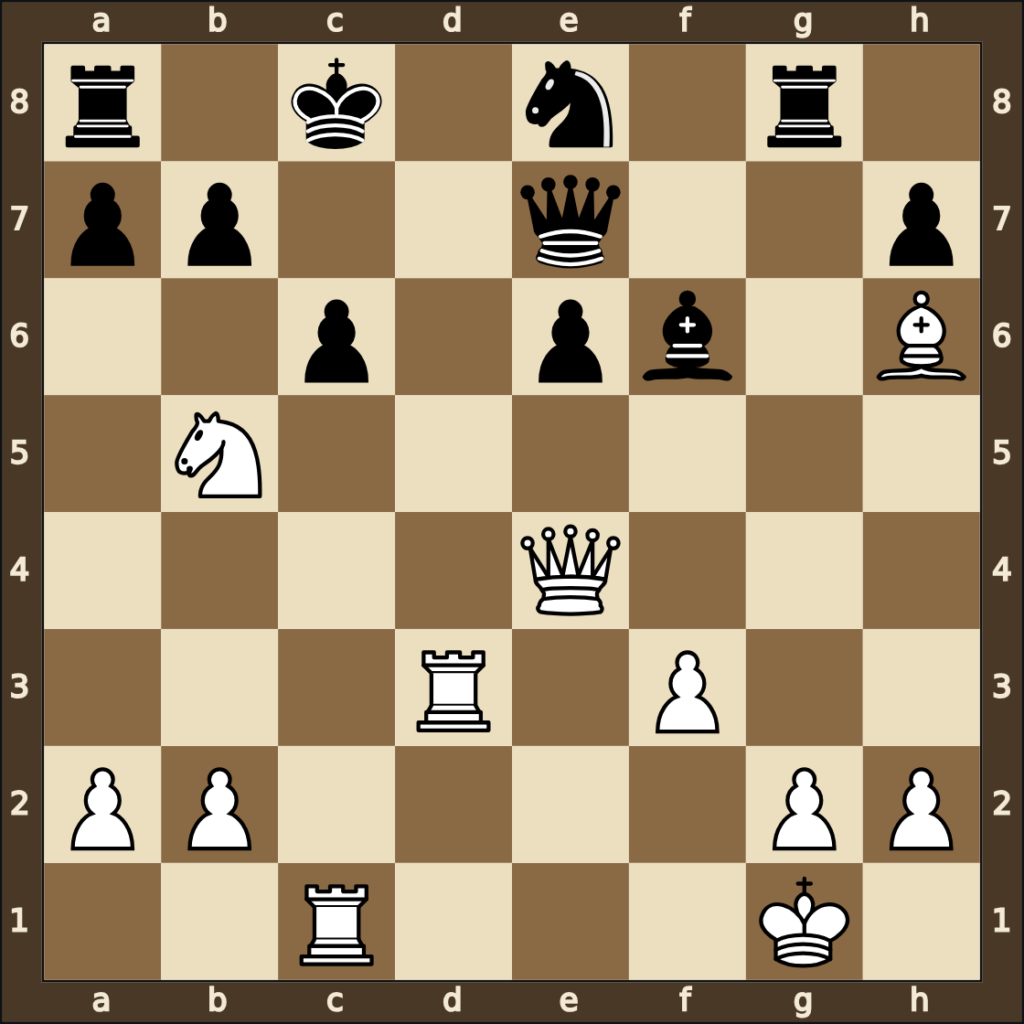
White to play. This one isn’t a single flourish — it’s a five-move sequence with real branches. Black has more than one way to meet your first move, and you need to have worked out that all of them fail before you play it.
One more, for the curious. A third game from that database deserves a mention, even if it isn’t a puzzle in quite the same sense: the Anand game from the top of this article. Its key moment — decades before Anand became a five-time World Champion — is a lesson in technique rather than a single crashing blow: a pawn move that looks like it throws away the position, and does the opposite. It’s on the solutions page too.
An invitation
John — if you’re reading this, Tunbridge Wells would love to have you back for another simul.
And if you’re a Tunbridge Wells local reading this instead: the club meets every Monday evening, 7.30pm, at 40 London Road. Beginners and future grandmasters equally welcome.
→ See both solutions, plus the Anand endgame, on the companion page.
Career and biographical details drawn from Wikipedia, the English Chess Federation, BritBase, Solefield School and contemporary reporting by Kent Online. Puzzle positions drawn from a personal ChessBase export of John Emms’s tournament games, 1982–2025, and checked with the Stockfish 16 engine.
Sources: Wikipedia — John Emms · Kent Online, Salomons Estate simul report · English Chess Federation · BritBase, 1997 British Championship crosstable · Solefield School interview · Tunbridge Wells Chess Club